
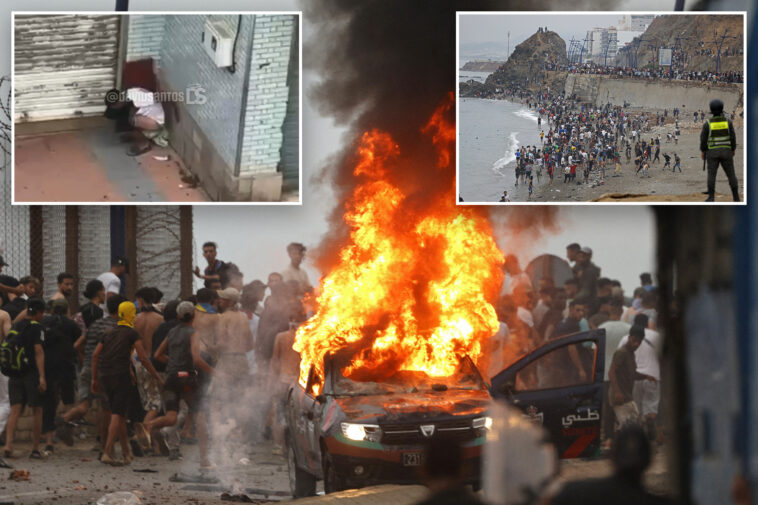

An unprecedented wave of nearly 50,000 illegal migrants from Africa has flooded the Spanish enclave of Ceuta, prompting Spain to deploy its military – as locals liken the invasion to an “apocalypse.”
Harrowing local media reports reveal residents and business owners in Ceuta – a Spanish territory located on the north African coast – are terrified to open their doors amid the rush of migrants, many of whom arrived wearing nothing but swimwear without a penny or possession to their name.
“Businesses closed. Shops shut because if you open a business, it gets overrun … We’re scared. The streets are packed. There are no measures in place. It’s every man for himself. They’re not giving us any help,” a terrified downtown restaurant owner who didn’t want to give their name told state-owned Spanish media outlet RTVE.


The shocking surge comes after a ruling by Spain’s Supreme Court earlier this month, which said migrants intercepted at sea while attempting to reach Ceuta or Melilla, another Spanish autonomous city in northern Morocco, cannot be kicked out under the enclaves’ special border-rejection regime.
“It has been a slow trickle since the Supreme Court’s ruling, but today has been an explosion,” a spokesperson for Spain’s Guardia Civil police told Reuters on Thursday.
Spain’s Interior Ministry estimated Friday that around 49,000 people had crossed by sea and land from Morocco over the past 24 hours.
Meanwhile, the socialist Spanish government — which just months ago launched a program to give legal status to some 500,000 illegal immigrants in the country — said it deployed 200 specialized police officers and 60 troops from the mainland to assist Ceuta’s own forces.
However, the reinforcements were powerless in the face of such a massive migrant deluge, which consisted mostly of military-age men.

“It’s like an apocalypse. Waves of people everywhere. You can see as many people wandering around as you want,” José Carlos Lara, owner of a sign-making business just over the border, told RTVE.
He said local authorities have “no capacity” to deal with the chaos, and that the new arrivals are already sleeping in the streets and washing themselves in public fountains.
A video shared on X by David Santos, director of right-leaning Spanish media outlet La Bandera, shows a migrant defecating on the side of a building in broad daylight.

Lara added that other business owners – particularly food stores – have shut their doors in a panic, fearing widespread looting.
“I’m not opening this afternoon because the situation is extremely tense … The first thing I have to do is protect my business and my family,” women’s clothing shop owner Enrique Serrano told Reuters, noting that businesses are taking self-defense matters into their own hands because they lack faith in cops’ ability to protect them.


The same is true of local residents, many of whom are afraid to walk the streets.
“People aren’t leaving their homes, only to buy food and then return. There’s a lot of uncertainty,” said Sebastián Antón, who works at a small supermarket in the middle of Ceuta. He compared the response of locals to what was seen during the darkest days of the pandemic.


“They’re buying huge amounts of food to fill their pantries as if something bad were going to happen.”