
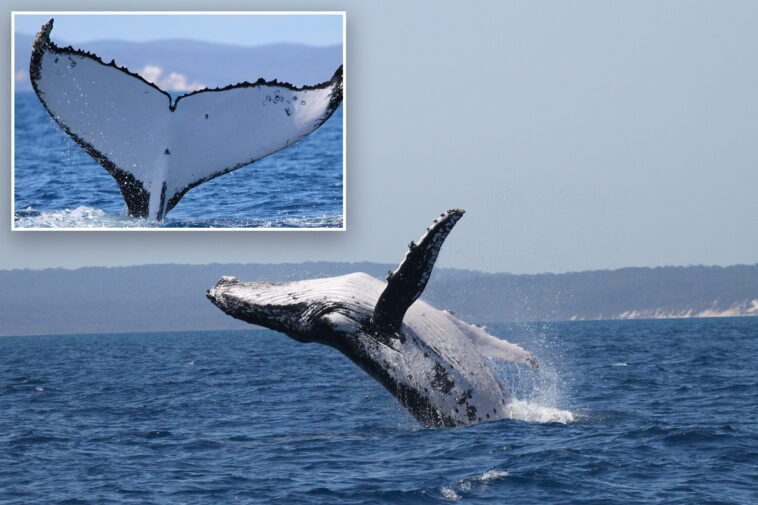
Scientists have spotted two humpback whales that made separate, record-breaking crossings between Australia and Brazil.
The whales were identified by their distinctive tail markings at the two locations about 9,000 miles (14,500 kilometers) apart.
They traveled in opposite directions and journeyed farther than any humpback known so far.


“It’s a very rare event, but it is a really wonderful demonstration of just how wide-ranging these animals are,” said Phillip Clapham, former head of a NOAA whale research program who was not involved with the new findings.
Humpback whales are known for roaming long distances across major oceans in predictable patterns, typically following migration routes learned from their mothers.
They feed on krill and small fish in the warmer months and breed in tropical waters over winter.
It’s difficult to track the movements of creatures that spend most of their lives underwater.
In the new study, scientists analyzed over 19,000 whale images taken in the past four decades by research groups and citizen scientists.
Recognition software helped to identify the whales based on their tails’ color patterns and jagged edges.
Researchers pinpointed two different whales at breeding sites in eastern Australia and Brazil over the years, suggesting they had crossed from one place to the other.

One whale traveled just over 9,300 miles (15,000 kilometers), outranking previous recordholders, including a humpback that swam from Colombia to Zanzibar.
The findings were published Tuesday in the journal Royal Society Open Science.
Since the photos only depict the whales at the beginning and end of their journeys, researchers don’t know the exact route they took.
Start your day with all you need to know
Morning Report delivers the latest news, videos, photos and more.
Thanks for signing up!
Whales don’t typically travel between mating sites, so it’s not yet clear why these two separately embarked on their journeys.
They may have met other whales on shared feeding grounds and split off instead of returning to where they came from, study co-author Stephanie Stack with the Pacific Whale Foundation said in an email.
“Finding not one but two individuals that have crossed between Australia and Brazil challenges what we thought we knew about how separate these populations really are,” Stack said.

Such odysseys are more difficult for whales in the Northern Hemisphere, where massive continents make traveling across oceans tougher.
Scientists said the record journey shows just how far humpback whales can go.
These methods can also help keep track of them as climate change warms oceans, possibly changing where krill live and where humpbacks might go to feed and breed.