
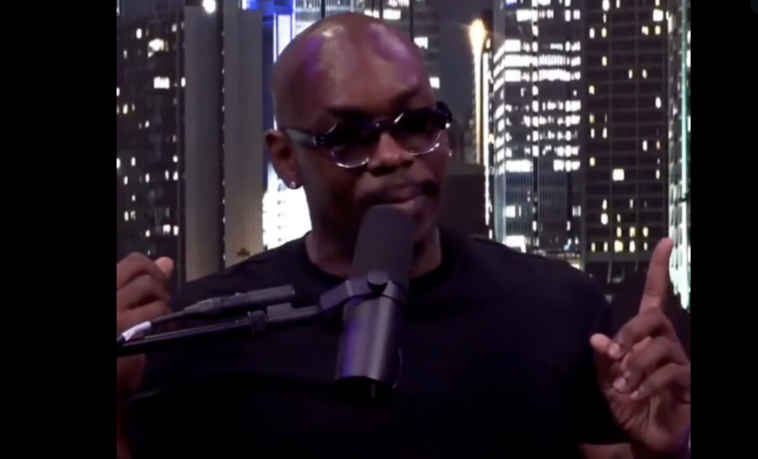

Talk show host Larry Reid has called for Black Americans to consider a “mass exodus” to Africa after Karmelo Anthony was sentenced to prison for the murder of Austin Metcalf, a case that has become another national flashpoint over violence, crime, justice, and public accountability.
Anthony was convicted of murder after fatally stabbing Metcalf during a high school track meet in Frisco, Texas, in 2025. A jury sentenced him to 35 years in prison, rejecting the idea that the killing should be excused or minimized as a tragic misunderstanding.
The case drew national attention because of the circumstances surrounding Metcalf’s death and the ethnocultural arguments that followed. The verdict, for many law-and-order conservatives, represented a rare moment of accountability in a culture too often eager to explain away violent crime when the politics become uncomfortable.
Reid, however, framed the sentence as an injustice and used the case to deliver a sweeping—and deeply misplaced—racial indictment of America. In remarks circulated online, the podcaster argued that Black Americans should begin thinking seriously about leaving the United States and returning to Africa.
Podcaster Larry Reid calls for a “mass exodus” of black Americans to Africa in response to the Karmelo Anthony verdict.
“I want you to begin to think about this America and the white people problem that we have… As a collective, let’s drain this place of its benefits and make… pic.twitter.com/M9zEVfcPqx
— Breitbart News (@BreitbartNews) June 11, 2026
“I want you to begin to think about this America and the white people problem that we have,” Reid said. “As a collective, let’s drain this place of its benefits and make our mass exodus and go home and build.”
Reid described Africa as the true home of Black Americans and argued that integration had failed to solve what he sees as the country’s deeper racial problem. His remarks were delivered in the aftermath of Anthony’s sentencing.
“Civil rights did not make white people that are infected with whiteness stop being racist,” Reid said. “They still raised racist children that run this country to this day.”
The comments immediately raised eyebrows because they came after a murder conviction in which the victim was a white teenager and the defendant was black. Critics called out Reid’s response, arguing that it appeared less focused on the dead young man and more focused on turning the case into another grievance campaign against white America.
Reid went further, casting Africa as a promised land from which Black Americans were historically removed. “You come from a land that flows with milk and honey,” he said.
“They pulled you out of that land ancestrally and brought you to a place to where your royalty was not recognized,” he continued. “Used your black power, your black mysticism, your African spirituality, and your physiological superiority to build this country and give everybody reparations except you.”
The rhetoric fits a long tradition of black nationalist calls for separation or emigration, from the founding of Liberia to Marcus Garvey’s Black Star Line. For more than two centuries, various movements have argued that Black Americans should seek a future outside the United States.
But the timing of Reid’s comments has made them especially controversial. He was not speaking in the abstract, but in response to the sentencing of a young man convicted of murdering another teenager at a school sporting event.
Anthony fatally stabbed Metcalf during a confrontation at a track meet, according to trial coverage. Prosecutors characterized the killing as murder, while the defense argued that Anthony acted in self-defense.
The jury rejected Anthony’s defense and sentenced him to decades behind bars. For Metcalf’s family and supporters, the case was not about ethnocultural politics, but about the loss of a son, brother, classmate, and young athlete whose life was tragically—and needlessly—cut short.
The response from the right has been sharply critical of activists and commentators who have attempted to recast Anthony as a victim of systemic injustice, arguing that America cannot maintain public order if even murder convictions are turned into opportunities to attack the country—and the majority population—rather than mourn the tragic, untimely death of a young person.
The case has also intensified debate about black-on-white violence and the way such crimes are discussed in the media. Similar cases are often sanitized, ethnocultural motives are avoided unless they fit approved narratives, and public sympathy is frequently redirected away from victims and toward offenders.
Reid’s comments offered a clear example of that inversion, according to his critics. Instead of focusing on Metcalf’s killing, he used the verdict to argue that Black Americans should leave a country he described as fundamentally hostile.
Reid’s audience may view his remarks as a provocative expression of frustration with America’s history, but opponents say the speech treated a murder sentence as a launching pad for resentment against Americans.
That, precisely, is what makes the reaction so explosive. A teenager is dead, another young man is going to prison for decades, and yet much of the public debate has once again shifted toward identity, grievance, and ethnocultural blame.
The central fact, for law-and-order voices, remains quite simple: Austin Metcalf was killed, Karmelo Anthony was tried, and a jury convicted him of murder. They argue that no ideological explanation should obscure the basic moral reality of the crime.
The case also exposes the growing divide between ordinary Americans who want safety and accountability and commentators who interpret nearly every institution through some kind of ethnocultural conflict. In such a climate, even a murder conviction can become proof of oppression to those determined to see it that way.
Reid’s call for Black Americans to “go home” to Africa is, of course, unlikely to become a mass political program, but it does reveal how far some voices—even perhaps a growing number—are willing to go in rejecting the idea of a shared American future.
Metcalf’s killing should have been treated first and foremost as a human tragedy and a criminal act. Instead, the aftermath has shown how quickly ethnocultural politics can swallow even the most basic question of justice.
The Anthony verdict may have closed the trial, but the national argument it appears to have triggered, unfortunately, is not over. Reid’s remarks have only deepened the dispute over whether America can still speak plainly about violent crime, victimhood, and accountability.
Ad block users: Some site features may not work correctly while an ad blocker is enabled, because they break scripts and content this website depends on. If you can’t see comments below, for example, please disable your ad blocker.


I agree with you. In my opinion blacks mostly always use the race card to protest. I for one always have said fuck Black Lives Matter. For me, ALL LIVES MATTER!
To all the blacks that don’t like it here, please go back to Africa, I’m all for it! Far as I’m concerned, most of you guys are the most racist people in the planet.