
Guest post by Linda Brickman
When election tools, voter data, State procedures, and Federal guardrails collide.
In the United States, election laws can look very different from one state to another. One State may allow same-day voter registration. Another may require earlier registration deadlines. One State may rely heavily on mail ballots. Another may impose stricter identification requirements. Some States participate in interstate data-sharing systems such as ERIC. Others have withdrawn or chosen different methods of maintaining voter rolls.
This article follows an earlier discussion of voter rolls and voter list maintenance. That article raised a larger question: if Federal law governs voter registration and election administration, why do State election procedures still differ so dramatically?
And that raises a simple but equally important question:
How much discretion do States actually have under Federal election law?
The answer begins with the U.S. Constitution. States have broad authority to administer elections, including the time, place, and manner of holding elections. That is why election procedures can vary so widely across the country. Arizona does not administer elections exactly like California. Texas does not operate exactly like Florida. Each state has its own laws, procedures, deadlines, databases, and election officials.
But State Authority is Not Unlimited.
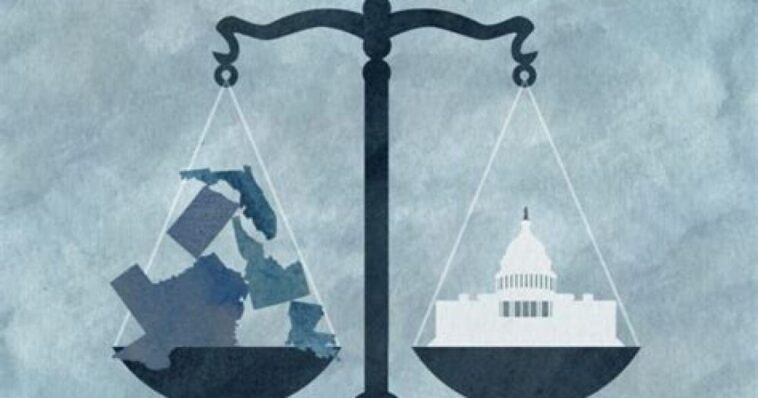
Federal law creates guardrails. Congress has enacted laws such as the National Voter Registration Act of 1993, commonly known as the NVRA or Motor Voter Act, and the Help America Vote Act of 2002, known as HAVA. These laws do not make every state election system identical, but they do establish certain national standards for voter registration, voter list maintenance, statewide voter registration databases, and protections for eligible voters.
And that is where the debate begins.
Where does lawful discretion end, and where does legal conflict begin?
If Federal law sets the floor, how high may States build their own election systems above it?
- When does state discretion become innovation?
- And when does it create legal conflict?
- Or when does it undermine public confidence?
These questions matter because State election procedures directly affect voter rolls, ballot access, election security, transparency, and public trust. A State may claim it is expanding access. Critics may argue that the same policy weakens safeguards. A State may claim it is improving list maintenance. But critics may argue that the method raises privacy, accuracy, or political concerns.
ERIC is One Example.
The Electronic Registration Information Center was created as a data-sharing tool to help States identify voters who may have moved, died, or registered in more than one jurisdiction. Supporters describe ERIC as a useful method for improving voter-roll accuracy. Critics argue that ERIC raises serious concerns about governance, data sharing, outside influence, privacy, and its requirement that member states conduct outreach to eligible but unregistered individuals.
The ERIC debate is not only about one organization. It is part of a larger question: who should control the tools and data used in election administration?
Should States rely on interstate data-sharing organizations? Should voter-roll maintenance be handled entirely within State government? What level of transparency should be required when voter data is shared? What safeguards should exist before any outside system influences how election officials identify registration records for review?
Those questions are Not Theoretical…
In recent years, some States have remained in ERIC, while others have withdrawn and pursued alternative list-maintenance methods. That alone demonstrates how much discretion States still exercise within the Federal framework.
But discretion cuts both ways…
State flexibility allows States to respond to local needs, population changes, technology, voter behavior, and administrative challenges. At the same time, too much variation can leave citizens wondering why election procedures differ so dramatically depending on where they live.
And that is where Public Confidence enters the conversation.
Voters are often told that election laws are being followed. But many citizens do not know which laws apply, who enforces them, or where the line exists between State authority and Federal oversight. When that line becomes unclear, distrust grows.
The issue is not whether states have discretion. They do.
The issue is whether that discretion is being exercised transparently, lawfully, and in a manner that protects both election integrity and the rights of eligible voters.
States should not be treated as mere administrative branches of the Federal government. The Constitution gives them a central role in election administration. But neither should States be permitted to use discretion as a shield against accountability.
That is why citizens should be asking better questions:
- What does state law allow?
- Who is responsible for enforcement?
- What procedures are written in statute, and what procedures are created by administrative rule or election manual?
- When outside organizations, private vendors, or interstate data-sharing systems are involved, what transparency exists?
- And when a State’s election procedures appear to stretch beyond the public’s understanding of the law, who has the authority — and the courage — to challenge them?
Election integrity does not depend only on counting ballots. It depends on whether citizens can understand and trust the rules used before the first ballot is ever cast.
The real question is not whether States have discretion under Federal election law.
THEY DO!
The real question is: Where does lawful discretion end, and where does legal conflict begin?
Final Key Takeaways
✓ States have broad authority to administer elections, but that authority is not unlimited.
✓ Federal law creates guardrails through the Constitution, NVRA, HAVA, and other election-related statutes.
✓ Because States write and administer many of their own election procedures, election rules can vary dramatically from State to State.
✓ ERIC is one example of how an election administration tool can become a national debate over data, privacy, transparency, outside influence, and public trust.
✓ The question is not whether States have discretion. They do!
✓ The real question is where lawful discretion ends, and legal conflict begins.
✓ Citizens should not wait until Election Day to understand the rules. The laws, procedures, budgets, and legislative decisions made before an election often shape the election long before the first ballot is cast.
Endnotes
- S. Constitution, Article I, Section 4, Elections Clause.
- OJ NVRA List-maintenance guidance.
- HAVA statewide voter-registration database requirement, 52 U.S.C. § 21083.
- DOJ overview of the NVRA / Motor Voter Act.

© 2026 Linda Brickman. All rights Reserved.