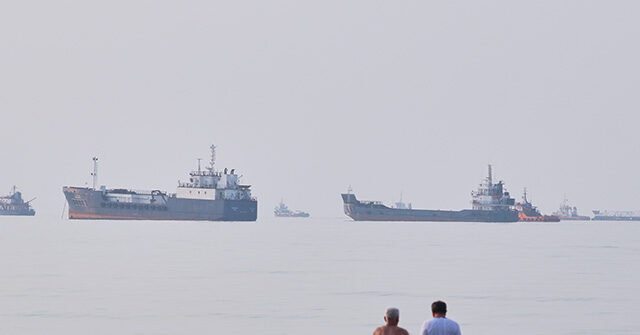
Ship tracking firms reported that two supertankers carrying crude oil from Saudi Arabia were attacked in the Strait of Hormuz on Monday night.
The tankers were struck by “unknown projectiles” within minutes of each other while passing through the strait near midnight.
The two Very Large Crude Carriers (VLCC), the Saudi-flagged Sidr and Liberia-flagged Senegal Prosperity, each loaded cargoes of about two million barrels of crude oil from Saudi Arabia’s Juaymah terminal last week.
WATCH — President Trump: I’m the Last Person to Trust Iran:
Saudi Arabia’s national oil company, Aramco, suspended loading from the Persian Gulf terminal of Juaymah in February due to a structural collapse. The suspension was extended during the Iran conflict until Juayman was finally reactivated in mid-August. Another suspended Persian Gulf terminal at Ras Tanura was reactivated after a four-month suspension in June.
Aramco has been selling oil from Juayman and Ras Tanura via ship-to-ship transfers off the coast of Fujairah, a port in the United Arab Emirates (UAE) on the coast of the Gulf of Oman.
According to the Athens-based Marisks ship tracking firm, the Sidr was hit by unknown projectiles while sailing about 16.6 nautical miles northeast of Khasab, Oman.
A few minutes later, the Senegal Prosperity was hit by three projectiles while sailing about half a nautical mile further northeast of Khasab. The attack on Senegal Prosperity was confirmed by the United Kingdom Maritime Operations (UKMTO) center.
“No casualties or environmental impact has been reported. Authorities are investigating. Vessels are advised to transit with caution and report any suspicious activities to UKMTO,” the center said.
Maritime security firm Vanguard said the three projectiles launched at Senegal Prosperity were rockets, and they struck the ship on its port side, engine room, and ballast tank.
“The near-simultaneous incidents represent a further escalation in the threat environment within the Omani corridor,” Marisks said.
President Donald Trump said on Monday that the Strait of Hormuz is in “very good shape” and under U.S. control.
“Many, many ships got through last night, as you know, with the Navy’s assistance, and we’ve been averaging 30 ships a night,” Trump said.
“That’s a lot, and a lot of oil is coming out. That’s why you haven’t seen the price of oil go like they thought it might have to go,” he said.
Oil prices rose on both Monday and Tuesday as the markets reacted to renewed hostility in the Strait of Hormuz. The European benchmark, Brent crude, rose to $91.48 per barrel, while America’s benchmark West Texas Intermediate hit $86.97 per barrel.
“Despite satellite tracking firms suggesting oil flowing through Hormuz is around 6 million barrels per day, that is well below pre-conflict levels,” said analysts from ANZ in Australia and New Zealand.
“In the meantime, the buffers the global oil market has been relying on are becoming exhausted. U.S. inventories are nearing minimum levels, while China’s ability to keep imports low will be tested as seasonal demand picks up,” ANZ added.